maibank
 maib business app
 new internet banking - maib business
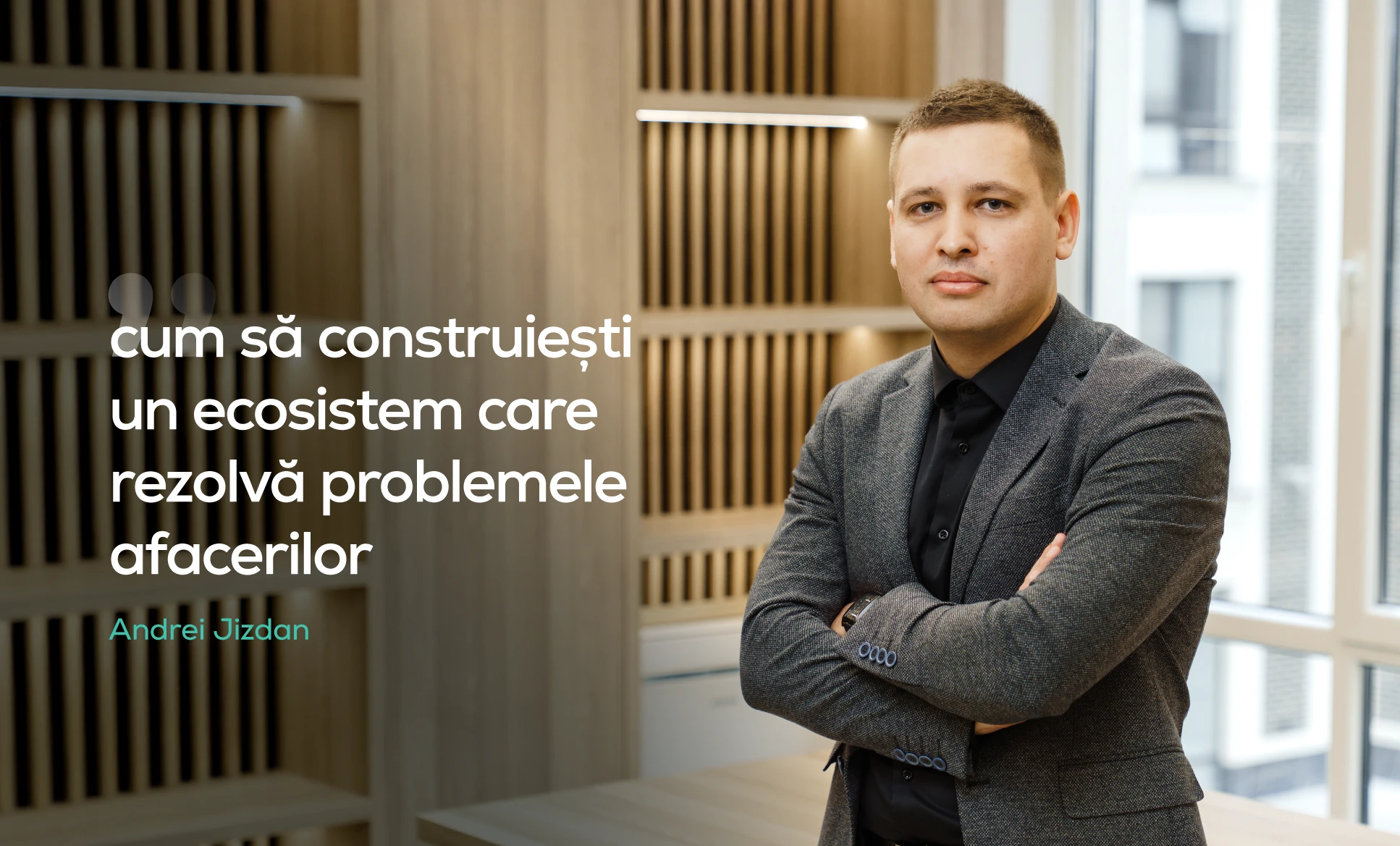
An interview with Andrei Jizdan, Founder and CEO of Jizdan & Partners
Andrei, good afternoon. Let’s start with Jizdan & Partners. How would you define the company’s core business and positioning today?
In the beginning, I described Jizdan & Partners in a classic way, as an accounting and legal services firm. Over the years, though, our approach has changed completely. Today I’d rather say that we provide complex solutions to our clients’ problems in accounting, tax planning and legal matters.
To put it simply, we solve problems. We don’t just process source documents or file reports. Those are the two core areas of our business. Over the years, a whole ecosystem of related services has grown up around them, and modern companies in Moldova find it harder and harder to operate without these services.
Let’s start with accounting. How large is that part of the business today?
We currently provide ongoing accounting services to about 300 companies. That’s a fairly large portfolio for the Moldovan market, especially since we work with medium-sized companies and fast-growing small businesses.
You’ve been on the market for more than ten years. How did it all begin? Do you remember your first steps? Did you start with accounting or legal services?
With accounting. I graduated from the Academy of Economic Studies of Moldova (ASEM) in 2014, so finance and accounting was the field I knew best professionally and felt closest to.
I didn’t start my own business right after graduating. First, I worked at two accounting firms, and then I joined Ruslan Uscov’s team. That was an extremely valuable experience. It’s where I came to a key conclusion that shaped how I see things: clients are willing to pay, and should pay, a fair price for thorough, high-quality advisory services.
After that, things developed quite naturally. Over time, entrepreneurs I knew began contacting me directly, my first clients came along, and, at some point, I realised very clearly that I was ready to work for myself.
I remember very well the moment I started the business. In the office on Zaikin Street there were four desks for future employees and a separate one for me. I didn’t have any employees yet, so I worked at one of the desks meant for my future colleagues. But whenever a prospective client came in, I would make a show of moving to “my” desk. After all, the client had come to a proper company that already had a team. That memory makes me smile today, but every one of us started from zero at some point.
The most important thing I demanded of myself from day one was iron discipline. I came into the office every day at eight or nine in the morning and left at a set time. Even if I didn’t get a single call for half the day, I stayed in the office, learned something new or worked through ideas. It mattered to me to treat my own work as a real business, organised and structured, right from the start.
Now that you lead the company, do you still work with clients personally?
Yes, and I do it on principle. I still personally manage the relationship with a large IT company, and, of course, I look after my own businesses. I think it’s very important not to lose touch with day-to-day practice and the realities of operations.
If you stop working directly with clients and stop following changes in legislation, accounting entries and banking procedures closely, it eventually becomes very hard to manage your staff well. There’s also a dangerous risk: at some point you may start to believe you’re the smartest and best expert on the market. That’s simply not true. There will always be someone who understands certain details better than you do. And the work itself still gives me real professional satisfaction.
How many people work at Jizdan & Partners today?
Our team currently has 24 specialists: accountants, lawyers, HR specialists and technical staff.
Do you remember when the company went through a major transformation, going from four empty desks to a team of more than 20 specialists?
Rapid growth began about three years after we launched. In the first three years we grew gradually, at a fairly slow pace. The growth was steady, just not very noticeable from one year to the next.
The real turning point, and the main driver of our growth, was the launch of Moldova’s special Moldova IT Park tax regime. IT companies and startups began coming to us in growing numbers. Although I was a fairly young accountant at the time, I already knew a lot about international e-commerce, how payment systems like PayPal work, how international online marketplaces operate, and currency regulations.
We were able to offer the IT sector clear, accessible services from the start, both in how we communicated and in our procedures. I believe the strong reputation we have on the market today comes largely from our work with the IT industry.
What share of your client portfolio do IT companies make up today?
About 57%. At one point I was even tempted to reposition Jizdan & Partners completely as an accounting firm that served only IT businesses.
I’m glad I dropped that idea in time and kept a diversified portfolio. A large share of our clients work in retail, services, construction and trade. If the global IT sector went into stagnation or crisis, such a narrow focus would leave us exposed. Diversification gives us stability and a financial cushion that helps us get through difficult times.
Another important stage in the company’s development was launching a specialised service for verifying the activity of Moldova IT Park resident companies. By law, residents must confirm every year that they still meet the park’s eligibility criteria. We organised this process very well, which let us serve not only our regular clients but also bring in other IT companies.
The past few years haven’t been easy for business. How do you respond in a crisis?
We expand. In October 2022, despite a very difficult geopolitical situation and the war in the region, we made the strategic decision to move to new premises. A very good opportunity had come up to buy commercial space at an attractive price. The risks were enormous, but we decided to take them.
The new office was 140 square metres at first, and today we’ve already expanded to 226 square metres. We used bank financing for the purchase and also put in some of my personal savings. It was a risk, but it turned out to be fully justified.
How did the company’s second core area, legal services, develop?
I’ve always wanted to have as broad an expertise as possible. Accounting stayed my core field, but alongside it I was always involved in HR, payroll and drafting contracts. I was also very good at registering legal entities from the very beginning.
Gradually I gained experience registering companies with complex ownership structures, where the shareholders are foreign legal entities, offshore entities or holding companies. A separate legal department with a full range of services grew step by step around these complex business registration services.
We were among the first consulting firms to make active use of fully online, remote business registration tools. For us this was a huge technological leap: we no longer had to stand in queues ourselves or coordinate paperwork with different institutions. Thanks to digital solutions, everything became faster and more transparent.
Later we began drafting complex commercial contracts. Today we provide legal support for large deals involving the sale and purchase of businesses, as well as venture capital investments. Our legal department works with foreign investors, startups and international legal teams.
Could you give us a few examples of complex deals you’ve handled?
For example, we were directly involved in supporting a deal in which the well-known Moldovan startup Planable raised investment and restructured its business with the participation of an American company. Legal teams from Moldova, the US and Romania worked on the deal, and we were responsible for all its tax and financial aspects on the Moldovan side.
Later, we had another client in a deal where Planable was itself the investor. We supported that deal from start to finish. It used legal mechanisms that are quite rare on our market, such as drag-along rights (the right to force other shareholders to join a sale) and tag-along rights (the right to join a sale of shares). In Moldova, these kinds of contract clauses are still rarely used, and we are effectively helping to set the standards for them.
The deal involving the KENTFORD business centre, a landmark building in Chișinău, holds a special place in our experience. In this large-scale deal we represented the seller, providing expert advice and full legal support at every stage.
That’s how you arrived at the One Stop Solution concept. What does it mean for an entrepreneur?
It means solving all of a business’s problems in one place. An entrepreneur or foreign investor comes to Moldova and no longer has to look separately for a lawyer, an accountant, a real estate agent or a banking broker. Our One Stop Solution model covers all of that. We register the company and set up its corporate structure, take over all its accounting and HR administration, provide legal protection and draft its contracts, and offer not just a registered address but actual office space.
We currently manage about 957 square metres of office space in several business centres in Chișinău, which we rent to our clients. The entrepreneur gets a ready-to-use workspace with all utilities and services included, specialist support and complete infrastructure, without having to look for solutions outside our ecosystem.
Andrei, working with the financial sector is a key part of your business. Tell us more about your strategic partnership with maib. How does it work day to day?
Our partnership with maib is a perfect example of how a bank and a professional consulting firm working together bring direct benefits to the end client.
It all starts with a basic but very important service: helping newly registered companies open current bank accounts quickly. At first glance it looks like a simple formality. For an entrepreneur, though, and especially a foreign one, the process can turn into a real bureaucratic maze, full of questions about compliance, the source of funds and the required documents.
We take that burden off our clients. After registering the company, we send the complete set of documents directly to the people responsible at maib whom we work with. We know all of the bank’s standards and requirements very well. Once the account is open, we invite the client to the bank, where they sign the prepared documents in just a few minutes. No queues, no repeat visits, no trying to find out why something is delayed. In busy months, we help open 10 to 15 current accounts at maib for newly registered companies.
Why did you choose maib as your main partner in this area?
Many financial institutions in Moldova are now trying to offer similar partnership models. But maib was one of the first major banks to approach this process systematically and with the help of technology.
Paradoxically, our practical experience has shown that despite its impressive size, maib works much faster, more flexibly and more efficiently than smaller banks. We work directly with a dedicated personal manager at the bank who is focused on getting results quickly and can clear any obstacles promptly. For our business, this means we can be sure of meeting the deadlines we commit to with clients.
It also matters to us that maib offers companies an integrated approach to banking. Being able to get financing, payment solutions, business cards and banking service packages from the same bank lets us manage the company’s financial operations more efficiently. We save time and can focus on growing the business instead of dealing with everyday banking issues.
Opening accounts is an operational matter. What about more complex financial products, such as loans and investments?
That’s the second, and most important, area of our partnership with maib.
When a small or medium-sized business goes straight to a bank for a loan without understanding how the bank assesses applications, it is often turned down or keeps being asked for more documents. The entrepreneur simply doesn’t know how to present their financial figures properly.
We act as a bridge and a specialised intermediary between the entrepreneur and the bank. On the financial modelling side, we prepare professional financial forecasts and clear, transparent business plans that fully match the risk assessment methodology maib uses. We have also set up a separate grants department within the company. We help businesses obtain state co-financing and non-repayable grants through the Organisation for Entrepreneurship Development (ODA) and combine them with loan financing from maib. I also have to mention the “373” programme and commercial mortgage loans. In fact, we’ve come to appreciate the advantages of maib’s “373” programme not only through our clients’ experience but through our own. We actively use financing from maib under this programme to buy and develop our own commercial premises.
So for the bank, you essentially act as a quality filter and carry out a preliminary assessment of clients?
Exactly. Maib gets a vetted client with a transparent financial position, a very well-prepared set of documents and a clear financial model. The client, in turn, gets financing approved quickly, on the best terms on the market and without unnecessary stress. It’s a classic win-win-win partnership, where all three parties benefit.
What new areas do you plan to develop in the near future?
We see huge potential in GDPR (personal data protection). The regulatory requirements are very strict and the fines are substantial, but companies still don’t understand well enough how to comply with the rules.
We’re also developing a complex area where HR and law meet: occupational health and safety. But the most promising area is Financial Management, meaning the financial management of a company.
What does Financial Management mean in the context of the Moldovan market?
Put simply, our goal is to teach business owners to really understand their companies’ numbers. Most entrepreneurs in Moldova only look at the balance in their bank account or at their tax records. They don’t have a clear picture of their products’ real profit margins, they can’t foresee cash shortfalls, and they don’t fully understand the structure of their working capital.
Our mission is to introduce management accounting, give owners a clear, data-based picture of their business and show them where they are losing money and where they have room to grow. For a small or medium-sized business, hiring a full-time CFO is very expensive. Our financial management consulting services give the entrepreneur the same level of financial analysis within our ecosystem.
To conclude, what is the core philosophy of Jizdan & Partners today?
We take on all the complex, routine and risky operational work. That runs from the first signature needed to register the company and quickly opening an account at maib, to legal support for deals, filing reports and finding office space.
Our main goal is to give entrepreneurs the freedom to spend their time and attention on what really matters: developing their products, growing sales and expanding their business. We take care of everything else.